 Vlad Kalashnikov is Head of Products at CFOUR Comply, an inline XBRL (iXBRL) conversion software. Through direct involvement in customer onboarding, he works closely with teams navigating these requirements, giving him firsthand insight into the operational realities firms face with tagging and the challenges corporate service providers encounter delivering these services at scale.
iXBRL software is required for ESEF, CSRD, SBR, and MiCA submissions. If you are new to these requirements, see ESEF Reporting Explained and What is XBRL Filing? before evaluating tooling.
First-time filers often assume iXBRL implementation will take months. In practice, with the right iXBRL software, onboarding and first-time tagging can take a day or two. The difference lies in how the platform is designed — whether it focuses on raw iXBRL generation capability, or is built with the end user in mind.
What is iXBRL software?
iXBRL software is used to prepare, tag, validate, and generate reports in Inline XBRL format. Inline XBRL embeds structured XBRL tags directly into a human-readable XHTML document. This allows regulators to process data automatically while stakeholders read a standard report in a web browser.
In practical terms, iXBRL software acts as a compliance layer on top of an existing report. Finance, sustainability, or legal teams upload a finalised report — usually in PDF format — and apply tags from the relevant regulatory taxonomy. The software then validates the tagged report and produces the iXBRL output for submission.
Unlike traditional reporting tools, iXBRL software is not used to author reports or manage accounting data. Its role is to ensure that disclosures meet the technical and regulatory standards set by authorities such as ESMA, national business registries, and EU regulators. As digital reporting requirements expand, iXBRL software has become a mandatory part of the reporting process.
ESEF — EU listed company annual financial reporting
ESEF is the most established iXBRL requirement in the EU. Issuers publish annual financial reports in XHTML, and where IFRS consolidated financial statements are included, they must be marked up with iXBRL using the ESEF taxonomy.
The current ESEF taxonomy for FY2025 reports is ESEF Taxonomy 2024 (published January 2025). ESEF Taxonomy 2025 was published on 21 April 2026 and applies to FY2026 consolidated financial statements; as ESMA has confirmed no 2026 taxonomy update, the 2025 taxonomy also applies for FY2027.
For teams preparing their first ESEF submission, see our step-by-step ESEF compliance guide.
Who is impacted. Listed companies on EU regulated markets and the service providers supporting them.
MiCA — EU crypto-asset reporting
MiCA introduces EU-wide disclosure and data standards for crypto-assets. Under Article 2 of Commission Implementing Regulation (EU) 2024/2984 (the white papers ITS), crypto-asset white papers must be prepared in XHTML format using Inline XBRL 1.1 specifications. This requirement applied from 23 December 2025. ESMA published the XBRL taxonomy for MiCA white papers on 5 August 2025.
See what is Markets in Crypto-Assets (MiCA) for a full overview of licensing, scope, and disclosure obligations.
Who is impacted. Crypto-asset issuers preparing white papers and updates; crypto law firms and compliance advisers supporting issuers.
CSRD — ESG reporting and digital tagging
CSRD expands sustainability reporting obligations. Digital tagging under an XBRL taxonomy for ESRS is the expected direction; however, mandatory iXBRL tagging has not yet been formally adopted via EU technical process. Teams should prepare their data and processes now, ready to implement when the digital tagging requirement is mandated.
Note: Omnibus I (Directive EU 2026/470, in force 18 March 2026) has narrowed CSRD scope to companies with over 1,000 employees and over €450m turnover. The “prepare now, implement when mandated” approach for CSRD digital tagging remains appropriate pending final ESRS taxonomy adoption.
For CSRD scope and timeline, see what is CSRD and the CSRD timeline.
Who is impacted. Companies in scope of CSRD — after Omnibus I (March 2026): over 1,000 employees and over €450m turnover — and service providers building ESG reporting practices.
Netherlands SBR — member state digital filing
Dutch Standard Business Reporting (SBR) is one of the largest iXBRL adoption drivers in the EU, applying to a wide range of private companies — not only listed issuers. The Dutch Chamber of Commerce (KVK) requires SBR as the route for filing annual financial statements for most Dutch entities.
SBR is mandatory for financial years starting 1 January 2025, with accounts due from mid-2026 (Staatsblad 2024, 428). Both XBRL and iXBRL formats are accepted; iXBRL is the recommended format as it preserves report layout while carrying machine-readable tags. All submissions are validated against the SBR Conformance Suite 2025 (published January 2026).
Who is impacted. Dutch companies required to file annual accounts via SBR; Dutch accounting and advisory firms supporting those filings.
Managed iXBRL services vs. self-service software
Some iXBRL vendors offer a managed service: the vendor’s team handles tagging on behalf of the client, rather than providing software the client operates. Managed iXBRL suits companies with no internal tagging capacity, low filing volume, or complex first-year reports requiring specialist taxonomy interpretation. Self-service software suits teams that file regularly, want control over the tagging process, and have — or can develop — internal iXBRL capability.
Most enterprise-facing iXBRL platforms offer both options. When evaluating vendors, confirm whether “managed iXBRL” includes taxonomy mapping support, validation, and amendment handling, or is limited to tagging alone.
XBRL vs. iXBRL — an important boundary
Some regulatory regimes use XBRL data submissions that are not Inline XBRL and do not use XHTML reports. In those cases, companies need XBRL data production and validation, but not necessarily iXBRL software designed for tagging human-readable documents. This distinction matters when scoping tooling and internal processes.
Key Criteria When Choosing iXBRL Software
Ease of use for non-technical teams
iXBRL tagging is typically handled by finance, sustainability, or legal teams — not by developers. Software designed specifically for iXBRL tagging tends to have a shorter learning curve than multi-purpose reporting platforms that include tagging as one of many features.
Cloud-based iXBRL tools are faster to set up: no local installation, no IT configuration, access through a web browser. For first-time filers facing a near-term deadline, a cloud-based tool is the more practical option.
Validation and submission engine
The software must validate against both iXBRL technical rules and regulation-specific taxonomy requirements. The Fujitsu Interstage XWand is a widely recognised engine for iXBRL validation. Confirm which engine a platform uses and verify that it validates against the specific taxonomies you need — ESEF Taxonomy 2025 for FY2025 ESEF reports is ESEF Taxonomy 2024 (published January 2025); the SBR 2025 taxonomy and Conformance Suite 2025 for Dutch SBR filings; and the MiCA XBRL taxonomy (published August 2025) for crypto-asset white papers.
Collaboration and review functions
Multi-user access is important when several team members work on the same report under deadline. Structured review workflows — separating preparer, reviewer, and auditor roles — reduce version conflicts and rework during the final approval stage.
Multi-framework coverage
Companies subject to more than one iXBRL obligation benefit from a platform that covers all required frameworks. A single platform for ESEF, CSRD, SBR, and MiCA reduces the number of tools to learn and maintain, and supports consistency across submissions.
iXBRL software comparison: what to look for
For teams evaluating tools side by side, the following criteria provide a structured basis for comparison:
| Criterion | What to check |
|---|---|
| Frameworks supported | Whether it supports the taxonomy required by your regulation |
| Onboarding time | Cloud setup vs. installation – installations typically take longer |
| Validation engine | Whether it is powered by a certified XBRL engine |
| Collaboration | Role-based access, ideally allowing auditors to access the software directly |
| AI / automation | Smart suggestions and workflow automation |
| Managed service option | Whether the vendor offers managed tagging and what is included |
| Multi-entity management | Enables centralised management of reports |
CFOUR Comply — cloud-based iXBRL software
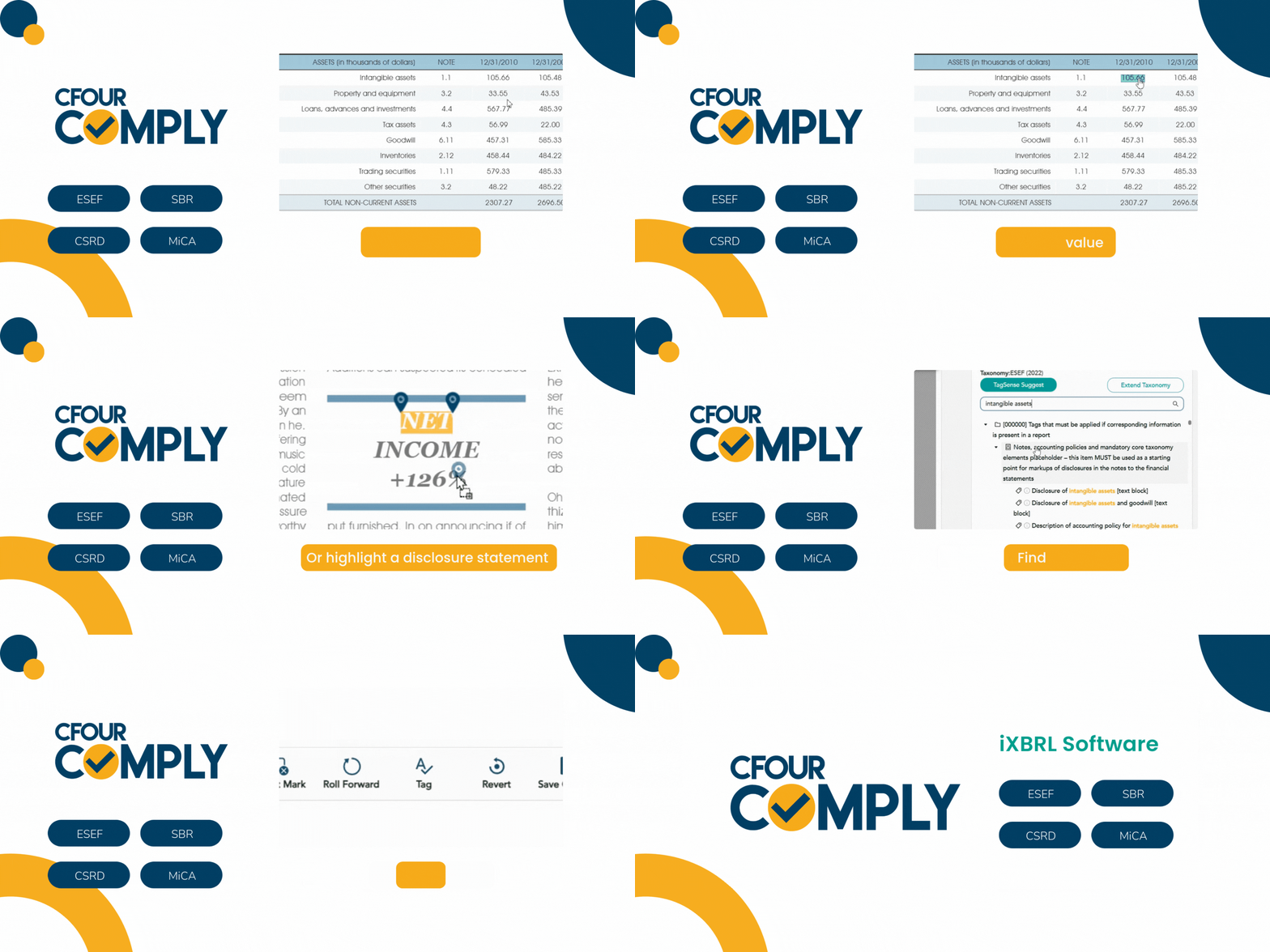
CFOUR Comply is a cloud-based iXBRL software platform that can be onboarded in under 24 hours. It supports ESEF, UKSEF, CSRD, SBR, and MiCA. Reports are uploaded in PDF format, converted to XHTML, and tagged within a shared workspace. AI-based tag suggestions assist with narrative disclosures, and roll-forward allows tags from prior submissions to be reused.
Validation is performed using the Fujitsu Interstage XWand engine. For corporate service providers and multi-entity groups, CFOUR Comply provides multi-entity management with role-based controls for versioning and access levels.
iXBRL software is now a core requirement across European financial, sustainability, business, and crypto-asset reporting. Choosing a tool that is efficient and easy to use is the best way to establish a sustainable reporting process and support a fast learning curve for any upcoming regulatory changes.
A single, user-friendly platform that supports ESEF, CSRD, SBR, and MiCA allows organisations to standardise their reporting approach and reduce pressure during submission periods. For corporate service providers and groups of companies, it offers multi-entity management functionality, with roles assigned for control of versions and level of access.
Book a demo of CFOUR Comply to see how it handles iXBRL submissions across ESEF, SBR, MiCA, and CSRD.