


 Vlad Kalashnikov is Head of Products at CFOUR Comply, an inline XBRL (iXBRL) conversion software. Through direct involvement in customer onboarding, he works closely with teams navigating these requirements, giving him firsthand insight into the operational realities firms face with tagging and the challenges corporate service providers encounter delivering these services at scale.
Getting Started with ESEF Compliance
Transitioning to ESEF reporting can be challenging, especially for those new to the process. The learning curve involves understanding the ESEF taxonomy, mastering iXBRL tagging, and using the right software tools.
If you’re new to ESEF or need a refresher on its regulatory background, see What is ESEF?. For a broader overview of ESEF’s regulatory framework and ESMA’s annual taxonomy updates, see ESEF Reporting Explained.
This article provides a practical walkthrough of ESEF compliance steps, covering:
- Preparing for ESEF Compliance: Key steps to understand and implement ESEF requirements.
- Training and Resources: Training and external resources needed for successful ESEF reporting.
- Practical Steps to ESEF Compliance: A detailed walkthrough of creating an ESEF-compliant report.
- ESEF for Better Reporting: How to use ESEF to enhance transparency and efficiency.
- CFOUR Comply for ESEF: An introduction to CFOUR Comply and how it supports the ESEF compliance process
For 2026 annual reports, the applicable taxonomy is ESEF Taxonomy 2025, published 21 April 2026. FY2025 reports used ESEF Taxonomy 2024, published January 2025.
Preparing for ESEF Compliance: What You Need to Know
Complying with the European Single Electronic Format (ESEF) requires careful planning, training, and the right tools. Key steps:
 1. Understand the requirements. The first step is to fully understand ESEF’s requirements, including mandatory use of XHTML for reporting and iXBRL for tagging financial data. Companies should familiarise themselves with the ESEF taxonomy — the version applicable to their reporting year — and how it maps to their financial statements.
2. Assess current systems. Evaluate existing financial reporting systems and processes to identify gaps in capabilities or compliance. This assessment highlights areas that need enhancement or change to meet ESEF requirements.
3. Implement necessary changes. Based on the assessment, implement changes to reporting processes. This may include restructuring data collection and reporting practices to align with ESEF standards.
4. Choose appropriate technology. Select software that supports XHTML conversion and iXBRL tagging, and provides validation of reports against ESEF taxonomy requirements before submission. See how to choose iXBRL software for a guide to evaluating tools.
5. Test the process. Before submitting live reports, conduct thorough testing to confirm tagging accuracy and report format meet ESEF standards.
6. Prepare for first submission. Assemble all required report components according to ESEF specifications and confirm the submission deadline with the relevant regulatory authority.
Training and Resource Considerations for ESEF Compliance
Staff training. Train finance and IT staff on ESEF reporting requirements and the tools in use. Training should cover XHTML formatting, iXBRL tagging specifics, and practical use of the selected software.
Continuous learning. Financial regulations and taxonomy versions change annually. Set up regular training sessions to keep the team updated on ESMA guidance and taxonomy releases.
External resources. Consider engaging specialist consultants in the initial implementation phase. These advisers can identify risks early and provide guidance on taxonomy interpretation and custom extension management.
The Practical Steps to ESEF Compliance
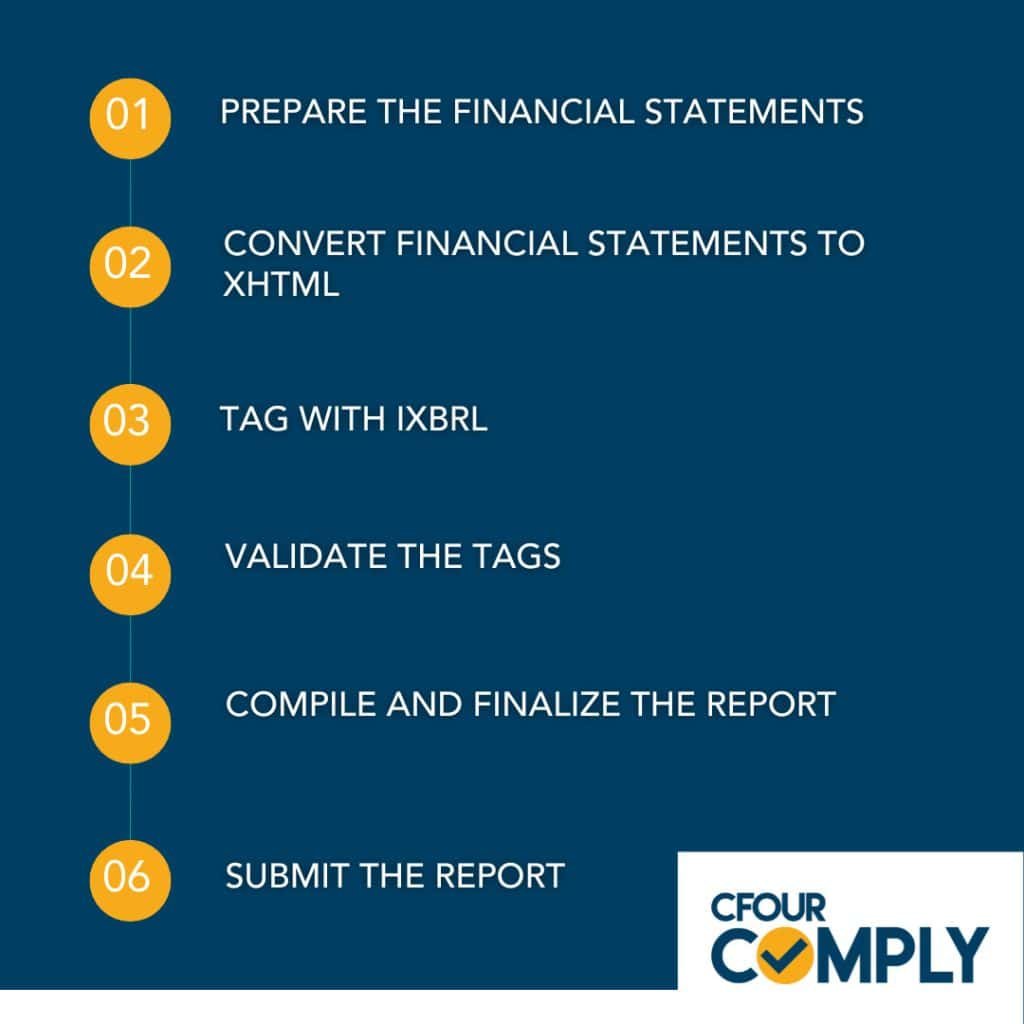
Steps to an ESEF-compliant report
Creating an ESEF-compliant report involves the following steps:
1. Prepare the financial statements. Ensure that financial statements are accurate and complete — balance sheet, income statement, cash flow statement, and all other relevant documents prepared in accordance with IFRS.
2. Convert financial statements to XHTML. Convert financial statements into XHTML format. XHTML is required for ESEF reports because it is both human-readable and machine-readable.
3. Tag with iXBRL. Apply Inline XBRL (iXBRL) tags to financial data within the XHTML document. Select the appropriate tags from the ESEF taxonomy and apply them to the corresponding elements in the financial statements. Tagging covers two categories:
- Primary financial statement elements. Start with primary statements, tagging revenues, assets, liabilities, and other required elements.
- Notes and disclosures. Extend tagging to the notes and disclosures section for comprehensive coverage of all reportable elements.
For background on what iXBRL filing involves, see how iXBRL tagging works in XBRL filing.
4. Validate the tags. Use validation tools to confirm tags are correctly applied according to the ESEF taxonomy. This step is required to avoid submission errors and to confirm compliance before filing.
5. Compile and finalise the report. Once tagging and validation are complete, compile all parts of the financial report into a single XHTML document. Review the document to confirm it meets all regulatory requirements.
6. Submit the report. Submit the ESEF-compliant report to the relevant regulatory authority by the required deadline, following the submission specifications provided by the authority.
Overcoming Common ESEF Reporting Challenges
Tagging Complexities
Tagging financial data with iXBRL presents several challenges, particularly for organisations new to the process or those with complex financial structures.
Choosing the right tags. Selecting appropriate tags from the ESEF taxonomy — which is extensive and detailed — can be demanding. Misinterpretations lead to incorrect tagging, affecting accuracy and reliability.
Handling extensions. When existing taxonomy tags do not precisely match a reporting item, companies must create custom tags (extensions). Managing extensions while ensuring they are anchored to standard tags requires careful attention to maintain compliance and comparability.
Applying correct tag properties. Accurately applying contexts, units, and sign logic in iXBRL tags is required for meaningful financial reporting. Errors in these properties lead to misinterpretations and compliance failures.
Addressing Data Accuracy Concerns
Ensuring the accuracy of tagged data is critical for compliance and investor trust. Common issues:
Human errors occur in manual tagging processes — wrong tag applied, inconsistent tagging across similar data types. Data integrity can be compromised during XHTML conversion or the tagging process, creating discrepancies between the tagged output and the original financial statements. Taxonomy updates add an ongoing layer of complexity: the ESEF taxonomy changes each year, requiring teams to verify tag mappings against the current version before each filing. The current applicable taxonomy is ESEF Taxonomy 2025, published 21 April 2026. It supports FY2026 consolidated financial statements. FY2025 reports used ESEF Taxonomy 2024, published January 2025. ESMA confirmed it will not issue a 2026 taxonomy, so the 2025 taxonomy also applies for FY2027.
Addressing these challenges with the right tools, proper training, and consistent quality assurance processes leads to more reliable reporting output and reduces the risk of submission errors.
What does successful ESEF iXBRL implementation look like?
Successful ESEF iXBRL implementation combines three elements: a taxonomy mapping process that is documented and repeatable, validation output that returns zero errors against the ESEF schema before any submission is made, and a team that understands both the financial content and the tagging requirements. Companies that achieve this typically have separated the XHTML conversion stage from the tagging stage, assigned clear ownership of the quality assurance step, and tested their approach on a prior period report before the first live submission.
Stay Informed and Equipped
Financial professionals should engage with new guidance from ESMA and monitor annual taxonomy releases. Teams responsible for ESEF reporting need training on XHTML formatting and iXBRL tagging, updated each year to reflect the current taxonomy version. Investing in validated, taxonomy-aligned reporting tools reduces manual effort and the risk of submission errors.
ESEF for Future Success
As ESEF reporting becomes an established part of financial disclosure for listed companies, ensuring your processes and tools are current is a matter of ongoing compliance management rather than a one-time project. ESEF solutions that support taxonomy validation and collaborative review reduce the manual burden on finance teams.
Get Started with CFOUR Comply for ESEF Compliance
ESEF compliance involves multiple technical requirements — taxonomy selection, XHTML conversion, iXBRL tagging, and validation. CFOUR Comply provides a built-in workflow covering each stage, with AI-assisted tagging to reduce manual effort and built-in validation against ESEF taxonomy requirements.
CFOUR Comply supports collaborative review, allowing finance teams, auditors, and stakeholders to work on the report in a shared environment. The platform also covers CSRD reporting requirements, providing a single tool for both ESEF and CSRD submissions.
FAQ - ESEF Compliance in Practice: Step-by-Step Guide
- What is the ESEF taxonomy and which version applies to my report?
The ESEF taxonomy defines the iXBRL tags that listed companies must use when tagging their financial statements. ESMA publishes a new taxonomy version each year. For FY2026 annual reports, the applicable version is ESEF Taxonomy 2025, published 21 April 2026. For FY2025 annual reports, the applicable version was ESEF Taxonomy 2024, published January 2025.
- What are the mandatory steps to create an ESEF-compliant report?
An ESEF-compliant report requires six steps: prepare accurate financial statements under IFRS; convert them to XHTML format; apply iXBRL tags from the ESEF taxonomy to primary financial statement elements and notes; validate the tagged document against the taxonomy; compile all parts into a single XHTML document; and submit to the relevant regulatory authority by the required deadline.
- What are the most common iXBRL tagging mistakes in ESEF reporting?
The most common issues are: selecting incorrect taxonomy tags for financial line items; creating extensions without proper anchoring to standard tags; and applying incorrect context, units, or sign logic. These errors often go undetected without dedicated validation tooling. Validation against the ESEF taxonomy schema before submission is a required step, not an optional check.
- What is the "esef ixbrl implementation success" metric?
Successful ESEF iXBRL implementation is defined by a validation-clean tagged report, zero schema errors, produced by a repeatable internal process. The markers of success are: documented taxonomy mapping, a separated and quality-assured tagging workflow, and at least one dry run against a prior period report before the first live submission.
- Does ESEF apply to CSRD reporting as well?
ESEF (European Single Electronic Format) applies specifically to the annual financial reports of listed companies under the Transparency Directive. CSRD (Corporate Sustainability Reporting Directive) has separate digital reporting requirements. However, CFOUR Comply supports both ESEF and CSRD reporting formats, so companies subject to both can manage them in a single platform.