
 Vlad Kalashnikov is Head of Products at CFOUR Comply, an inline XBRL (iXBRL) conversion software. Through direct involvement in customer onboarding, he works closely with teams navigating these requirements, giving him firsthand insight into the operational realities firms face with tagging and the challenges corporate service providers encounter delivering these services at scale.
You already know the Swiss Climate Ordinance applies to your company. The question left is how to produce a machine-readable disclosure without adding weeks to the reporting cycle, and what an XBRL tool does. This article explains it in detail using the example of CFOUR Comply – an XBRL software for Swiss Ordinance reporting.
How CFOUR Comply Supports Reporting
The Reporting Workflow, Step by Step
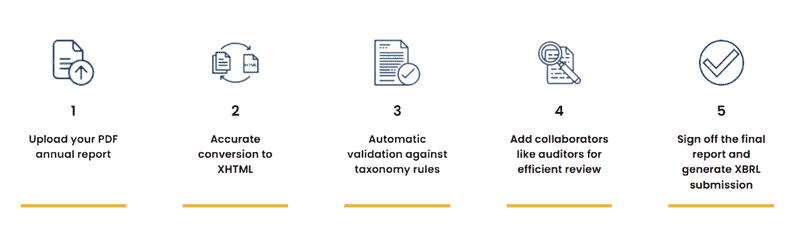
The process starts with uploading the existing PDF annual report (step 1). CFOUR Comply converts this into XHTML, preserving the original layout, fonts, and formatting rather than requiring the report to be rebuilt from scratch (step 2).
Once converted, tagging happens directly in the platform. The platform checks the tagging automatically against the applicable taxonomy rules before anything is submitted (step 3).
Customers of CFOUR Comply reported that this combination of automated suggestions and built-in validation cut the time needed to tag a report by around 70 per cent compared with manual preparation.
Auditors and other reviewers can be added directly to the platform, so tagging can be reviewed and signed off without exporting files or emailing versions back and forth (step 4). Once the report is approved, CFOUR Comply generates the final XBRL package ready for submission (step 5).
For companies filing again in later years, the roll-forward feature carries over the tagging structure and configuration from the previous submission, so each subsequent filing starts from what was already built rather than from zero.
The platform runs entirely in the browser, so there is nothing to install, and teams sign in through their existing Microsoft or Google account rather than managing a separate login.
For groups with more than one reporting entity in scope, multi-entity management keeps each entity’s tagging and configuration separate while remaining inside a single workspace.
Are XBRL-Generated Reports Mandated for 2026 financial year?
The Swiss Climate Ordinance does not currently require XBRL specifically. The Federal Council has confirmed that companies may submit their climate disclosures in either XBRL or PDF, with a comply-or-explain option available.
Comply-or-explain means a company can continue reporting in PDF instead of XBRL, provided it publicly states why it has not yet moved to a machine-readable format, and no deadline has currently been set for when that flexibility ends.
A full breakdown of the format requirement sits in our explanation of the Swiss Climate Ordinance.
Why Machine-Readable Reporting Matters Even Though XBRL Isn’t Mandated
That flexibility does not remove the need for moving to XBRL now. Machine-readable disclosures are directly comparable across companies and reporting periods in a way that a PDF is not, which matters as investors and regulators increasingly expect structured, queryable sustainability data.
Companies that wait for the comply-or-explain allowance to narrow, whenever that happens, will need to do the tagging work eventually. Doing it now, while the requirement is flexible rather than urgent, allows time to adopt the new format without stress.
Conclusion
Producing a Swiss climate disclosure in XBRL is a workflow of PDF upload, automated tagging, validation, and sign-off rather than a specialist technical exercise. With no mandate forcing the move today, the decision comes down to whether a company would rather build that capability on its own timeline or wait until the current flexibility narrows.
See the workflow in action during a live demo.
A short session shows the tagging, validation, and roll-forward features of CFOUR Comply.
Frequently Asked Questions (FAQs) about Swiss Climate Disclosure
- Do we need XBRL specialists to prepare a Swiss climate disclosure in CFOUR Comply?
Not necessarily. The platform is designed for finance and sustainability teams without specialist XBRL knowledge, and most first-time users complete their initial tagging within a single day.
- Does the Swiss Climate Ordinance require us to use an XBRL tool?
No. The Ordinance requires human-readable and machine-readable climate information but does not prescribe a particular software tool or expressly mandate XBRL. XBRL is currently the principal structured format being adopted by companies that publish machine-readable Swiss climate disclosures.
- Can our auditor review the tagging directly?
Yes. Auditors can be given access to review tagging within the platform itself, rather than reviewing exported files separately.
- Does CFOUR Comply support other reporting frameworks as well?
Yes. The same platform also supports ESEF, UKSEF, SBR, MiCA, and ESRStagging, so companies already reporting under Swiss climate disclosure can extend their usage to other frameworks and have their reporting unified.
- Can multiple reporting entities within the same group use the platform?
Yes. Multi-entity management lets a group manage tagging and configuration separately for each entity while keeping everything inside a single workspace, which matters for groups with more than one entity in scope.